
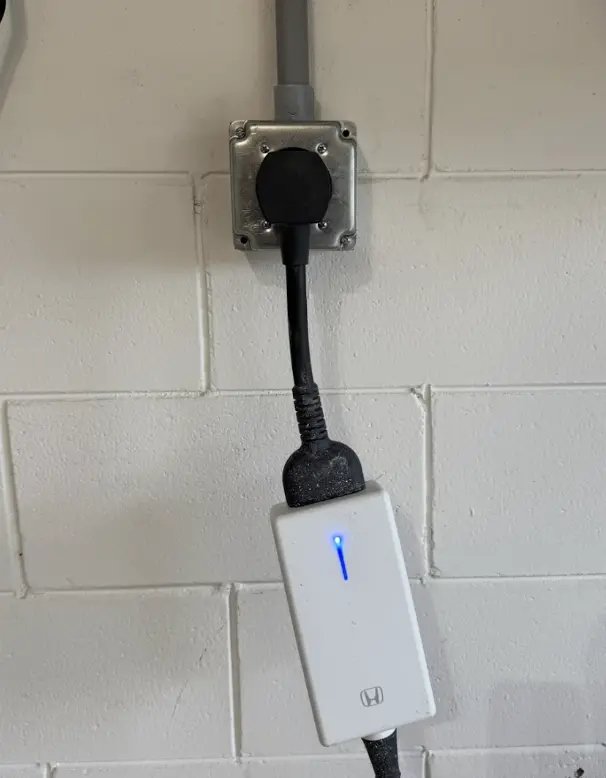
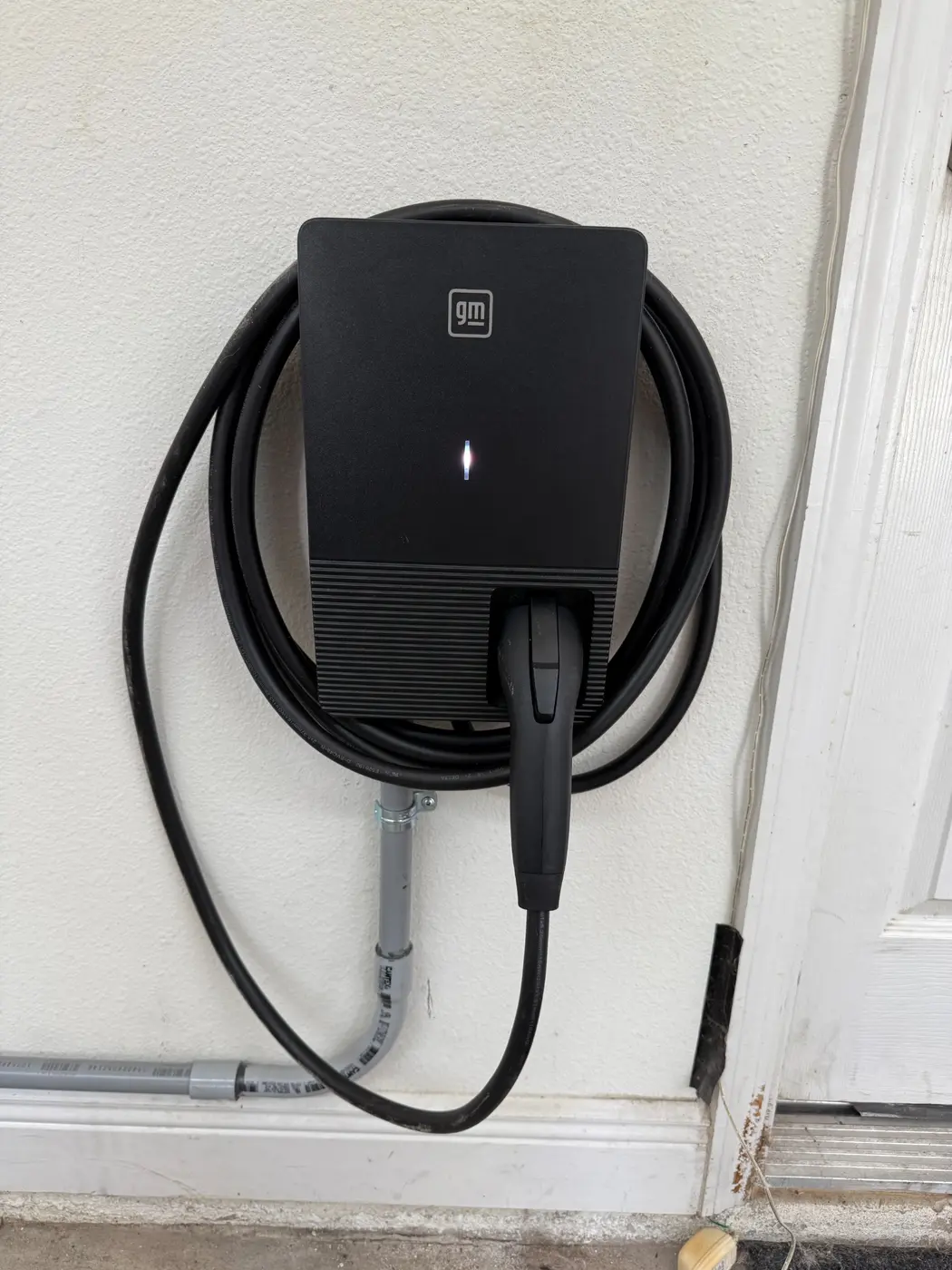
A NEMA 14-50 outlet gives you flexibility, but it does not automatically give you 40-amp charging. Most mobile charging cords deliver approximately 32 amps, while some plug-in units can provide up to 40 amps. A compatible hardwired charger can deliver up to 48 amps and removes the receptacle as an additional long-term maintenance point.
The differences at a glance
| Feature | Hardwired charger | NEMA 14-50 outlet |
|---|---|---|
| Typical output | Up to 48 amps with compatible equipment | Usually 32 amps with a mobile charger; some plug-in units support 40 amps |
| Connection | Conductors terminate inside the charger | Receptacle, plug and charger cord |
| Nuisance tripping | Less likely in a properly designed installation | May occur when the GFCI breaker interacts with internal charger protection |
| Best fit | Daily use and long-term reliability | Drivers who prioritize portability |
Final circuit sizing and charging output depend on the charger, vehicle, electrical capacity and approved installation design.
Why we generally recommend hardwiring
EV charging is a sustained electrical load that can continue for several hours. With a hardwired installation, the circuit conductors connect directly to the charging station. There is no receptacle and plug between the circuit and charger.
Removing those additional connection points simplifies the system and reduces the number of components that may loosen, wear or require replacement over years of use. This does not mean a properly installed NEMA 14-50 outlet is inherently unsafe. It means hardwiring generally creates the cleaner long-term design.
NEMA 14-50 charging is commonly 32 amps—not automatically 40
A NEMA 14-50 receptacle is commonly installed on a 50-amp circuit. Because EV charging is a continuous load, compatible equipment can draw no more than 40 amps on that circuit. That is the circuit's maximum continuous capacity—not a promise that every plug-in charger will use all 40 amps.
Many mobile or portable charging cords are designed for approximately 32 amps. Certain plug-in wall chargers can reach 40 amps, but the real charging rate is always limited by the lowest-rated part of the system: the circuit, charging equipment or vehicle.
Why nuisance tripping matters
Modern EV charging equipment includes internal ground-fault protection. A plug-in installation may also require a GFCI breaker under the electrical code adopted by the local jurisdiction. In some installations, these protective systems can interact and trip the breaker even when there is not a dangerous fault.
You may wake up expecting a charged vehicle and discover that charging stopped during the night. Repeated interruptions can also lead to service calls and uncertainty over whether the issue originated in the breaker, receptacle, charger or vehicle.
ChargePoint addresses this directly in its Home Flex installation guidance. The company recommends hardwiring when local codes require a GFCI breaker for the plug-in configuration and states that an upstream GFCI breaker can cause nuisance tripping because Home Flex already contains charging-circuit interrupting protection. Read the ChargePoint Home Flex installation guidance.
Strong warranties from reputable manufacturers
Established home-charger manufacturers commonly provide three- to four-year limited residential warranties. ChargePoint Home Flex and Wallbox Pulsar Plus are offered with three-year warranties, while Tesla provides four years of residential warranty coverage for its Wall Connector.
Those warranties apply to the charger subject to each manufacturer's terms. They generally do not cover a separately installed receptacle, plug connection, GFCI breaker or branch-circuit workmanship. A reputable hardwired charger reduces the number of separate components between the panel and the warranty-backed equipment.
When a NEMA 14-50 outlet still makes sense
- You already own a compatible mobile or plug-in charger.
- You expect to relocate the charger or take it when moving.
- Approximately 32-amp charging comfortably meets your needs.
- The outlet uses quality components suitable for sustained EV charging.
- You understand the potential for additional maintenance or nuisance tripping.
A plug-in charger should not be repeatedly disconnected without a reason. Frequent plugging and unplugging can wear the receptacle and weaken the connection over time.
The bottom line
For a primary home charging station that will remain installed for years, hardwiring is generally the better investment. It creates a cleaner installation, removes the receptacle as a potential maintenance point, may increase output from the 32 amps common to mobile chargers to as much as 48 amps, and can avoid GFCI-related nuisance tripping associated with some plug-in configurations.
Go Electric Chargers installs both hardwired Level 2 chargers and NEMA 14-50 outlets throughout Orlando, Sarasota and surrounding Florida communities. We review the charger, panel, installation location and charging goals before recommending the right option.
Ready for reliable home charging?
Send us your charger details and panel photos to receive an installation quote.
Frequently asked questions
Is a hardwired EV charger better than a NEMA 14-50 outlet?+
For most homeowners who plan to keep a Level 2 charger installed for several years, we generally recommend hardwiring. It removes the receptacle and plug as additional connection points, may support higher output and can avoid GFCI nuisance tripping associated with some plug-in installations.
How many amps does a NEMA 14-50 EV charger provide?+
A properly designed 50-amp NEMA 14-50 circuit can support up to 40 amps of continuous EV charging. However, many mobile or portable charging cords are limited to approximately 32 amps. Actual output depends on the circuit, charger and vehicle.
Why can a plug-in EV charger trip a GFCI breaker?+
EV charging equipment contains internal ground-fault protection. When a plug-in installation also requires a GFCI breaker, the two protective systems can sometimes interact and interrupt charging. ChargePoint specifically warns that this can cause nuisance tripping with Home Flex.
Can a hardwired EV charger charge faster?+
Yes, when the charger, vehicle and electrical system support it. Many reputable hardwired chargers can deliver up to 48 amps on a properly designed 60-amp circuit. Most mobile chargers connected to a NEMA 14-50 outlet provide approximately 32 amps, while some plug-in chargers support 40 amps.
Does the charger warranty cover the NEMA 14-50 outlet?+
Generally, no. A manufacturer's charger warranty normally applies to the charging unit itself, subject to its terms. The receptacle, plug connection, breaker and branch-circuit installation are separate parts of the electrical system.