
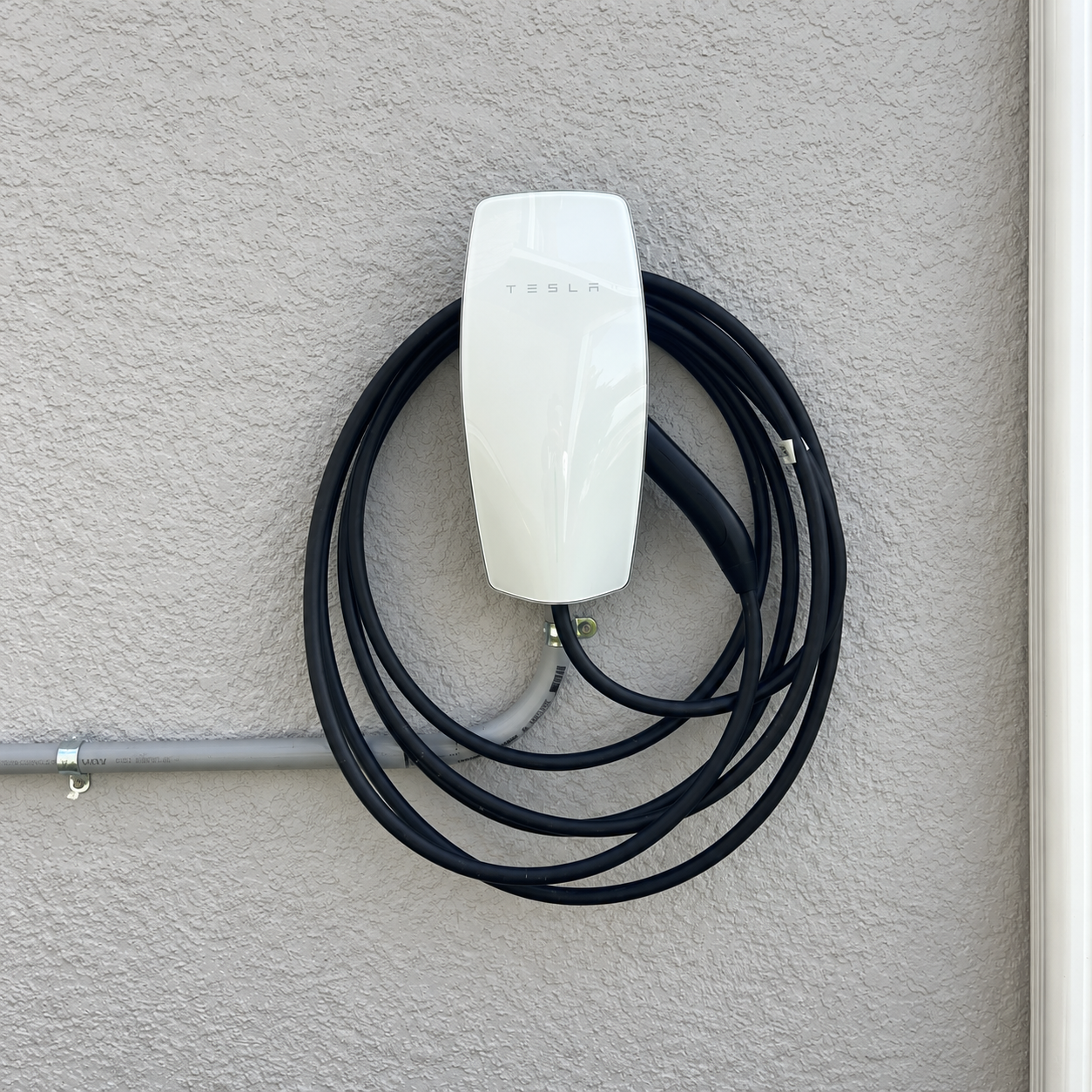
A garage is convenient, but it is not a requirement for charging an EV at home. Homeowners who park in a driveway or carport can often have a permanent charger installed outside—provided the charger, electrical design and mounting location are appropriate for outdoor use.
Outdoor EV chargers are designed for the elements
Manufacturers sell Level 2 chargers specifically designed for indoor or outdoor installation. These units use weather-resistant housings and sealed components intended to handle normal exposure within their published ratings.
Tesla describes its Universal Wall Connector as having a versatile indoor/outdoor design. The same general category of outdoor-rated Level 2 equipment is commonly installed at homes, hotels, workplaces and destination-charging locations.
Why we prefer hardwiring for an outdoor charger
For a permanent outdoor installation, we generally recommend a hardwired Level 2 charger. The electrical circuit connects directly to the charger instead of terminating at a plug-in receptacle.
Fewer exposed connection points
No receptacle-and-plug interface is added to the weather-exposed charging setup.
Designed around the location
The conduit, fittings, charger and circuit are planned as one outdoor installation.
Up to 48 amps when appropriate
A hardwired charger may support higher output when the vehicle and home electrical system allow it.
Plug in where you park
The cable stays ready beside the driveway or carport instead of being stored after every use.
Hardwiring does not make every charger suitable for outdoor use. The charger itself must also be approved by its manufacturer for the environment where it will be installed.
Will an outdoor installation void the charger warranty?
Installing a charger outdoors does not automatically void its warranty when the product is designed for outdoor installation and the installation follows the manufacturer's requirements.
Warranty length depends on the charger. Current examples include:
- Tesla Wall Connector: 48 months for normal residential use.
- ChargePoint Home Flex: three-year parts warranty.
- Wallbox Pulsar Plus: three-year limited warranty under normal use and service.
Coverage is never unlimited. Improper installation, modifications, abnormal use, physical damage and conditions outside the written warranty may affect a claim. Homeowners should keep the invoice, charger information and installation documentation.
What about Florida rain, heat and sunlight?
Florida adds several practical considerations: heavy rain, intense sunlight, humidity and long periods of heat. An outdoor installation should be planned around all of them.
- Equipment rating: Confirm that the exact charger model is approved for outdoor installation.
- Water management: Position and mount equipment so water does not collect around the charger, conduit entries or cable connection.
- Sun exposure: Consider the manufacturer's operating-temperature range and whether another suitable location offers less direct afternoon sun.
- Cable storage: Keep the charging cable and connector off the ground using the charger's dock or a compatible holster.
- Physical protection: Chargers near vehicles, walkways or shared parking areas may need thoughtful placement or additional protection.
A cover or small overhang can be helpful in some locations, but it is not a substitute for outdoor-rated equipment and a proper electrical installation.
Can someone use your outdoor charger without permission?
That concern comes up frequently when a charger is visible from the street. The practical answer depends on the charger and vehicle.
Tesla Wall Connector includes charging access controls. It can be configured for all vehicles, Tesla vehicles only or specifically authorized Tesla vehicles. Under the authorized-vehicle setting, approved Tesla VINs are entered into the charger's access configuration.
Other chargers may offer app-based locking, user access, RFID cards or similar controls. These features are model-specific, so they should be checked before purchasing if the charger will be accessible to neighbors, tenants or the public.
Where can an outdoor EV charger be mounted?
Common outdoor locations include:
- An exterior garage wall beside the driveway
- A wall inside an open carport
- A compatible pedestal or post near a parking space
- The side of the home near the vehicle's normal parking position
The best location is not necessarily the wall closest to the electrical panel. It should balance the wiring route, charging-cable reach, vehicle charge-port location, appearance and protection from accidental damage.
A Tesla Wall Connector has a long charging cable, but the connector should reach the vehicle comfortably without stretching across a walkway or creating a regular trip hazard. Planning for a future second EV can also influence the mounting position.
Are outdoor home chargers the same as public chargers?
Public charging includes several different equipment categories, but many hotels, workplaces, restaurants and destination-charging locations use the same type of outdoor-rated Level 2 wall connector found at a home.
That real-world use is a helpful reminder that these chargers are designed to operate outside. The difference is that a residential installation is configured for one household, while public or shared equipment may use different access, billing and networking features.
What should be checked before installation?
Before placing a charger outside, an installer should evaluate:
- The exact charger's outdoor rating and installation instructions
- The home's available electrical capacity
- The required circuit size and charging output
- The route from the electrical panel to the charger
- Exterior wall construction and mounting surface
- Exposure to vehicles, water, sunlight and landscaping
- Charging-cable reach and the vehicle's charge-port position
- Whether access control is important for the location
If electrical capacity is limited, an outdoor charger may still be possible with a lower charging rate or dynamic load management. Outdoor placement and electrical capacity are separate parts of the plan.
The bottom line
Yes, an EV charger can be installed outside. A properly selected outdoor-rated charger can live beside a driveway or carport and provide the same basic convenience as a charger inside a garage.
For permanent outdoor charging, we generally favor a hardwired setup using equipment approved for the environment. The charger should then be positioned around the home, the electrical route and where the vehicle is actually parked.
Product references: Tesla Universal Wall Connector, Tesla residential warranty, Tesla access control, ChargePoint warranty and Wallbox warranty.
Need charging where you actually park?
Go Electric Chargers installs hardwired outdoor EV chargers throughout Central and West Florida. We evaluate the equipment, electrical system, cable reach and exterior location together.
Frequently asked questions
Can an EV charger be installed outside in the rain?+
Yes. A charger specifically rated for outdoor use can be installed outside when it is mounted and wired according to the manufacturer's instructions and applicable electrical requirements.
Does installing an EV charger outside void its warranty?+
Outdoor installation does not automatically void the warranty of a charger designed for outdoor use. Warranty coverage still depends on the specific manufacturer, proper installation, normal use and the written warranty terms.
Should an outdoor EV charger be hardwired?+
We generally recommend hardwiring for permanent outdoor charging. It removes the receptacle and plug connection from the weather-exposed setup and can support higher charging output when the vehicle and electrical system allow it.
Can someone else use an outdoor EV charger?+
Some chargers include access controls. Tesla Wall Connector, for example, can be configured to allow all vehicles, Tesla vehicles only or specifically authorized Tesla vehicles by VIN. Features vary by charger.
Can an EV charger be mounted on a post?+
Many outdoor-rated chargers can be mounted on an exterior wall or a compatible pedestal or post. The final location must account for the wiring route, physical protection, cable reach and manufacturer requirements.
Will Florida heat damage an outdoor EV charger?+
Outdoor-rated chargers are designed to operate within a stated temperature range. Placement, direct sun, drainage and the manufacturer's operating limits should still be considered when planning a Florida installation.