
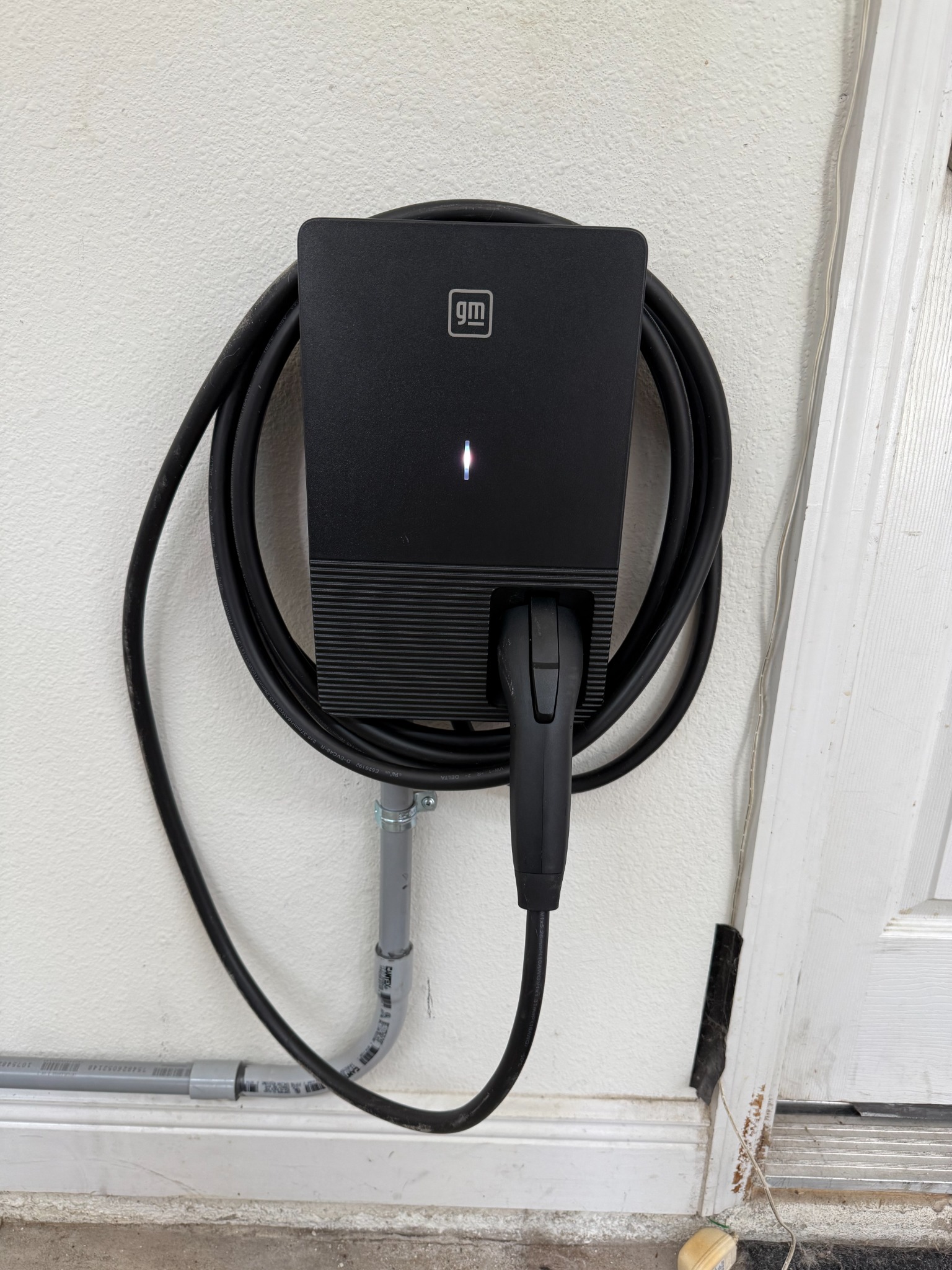
Most EV owners are not regularly charging an empty battery to 100%. They drive during the day, plug in at home and replace the energy they used while the vehicle is parked.
Think of it more like charging a phone than filling a gas tank. If you drove 40 miles today, your home charger usually needs to replace roughly 40 miles—not the vehicle's entire advertised range.
How fast does a Level 2 EV charger charge?
Level 2 charging uses a dedicated 240-volt circuit and delivers substantially more power than a standard 120-volt household circuit. Two common hardwired home configurations are:
Approximately 9.6 kW
Commonly configured on a dedicated 50-amp circuit.
Approximately 11.5 kW
Commonly configured on a dedicated 60-amp circuit.
EV charging is treated as a continuous electrical load, so charging output is generally limited to 80% of the circuit rating. The vehicle's onboard charger still determines how much of that available power it can accept.
How many miles can an EV add per charging hour?
A charger supplies electricity, not miles. The vehicle's efficiency determines how that energy translates into range. A smaller, efficient EV can add more miles from the same electricity than a large electric pickup.
The U.S. Department of Energy uses approximately 25 miles of range per hour as a general Level 2 reference. Actual results can be lower or higher depending on the vehicle, charging output, temperature and operating conditions.
What does overnight EV charging look like?
Suppose you arrive home at 7 p.m. and leave again at 7 a.m. That gives the vehicle a 12-hour charging window. It may only need a fraction of that time to replace the day's driving.
About 1 hour
Illustrative example at 30 miles of range added per hour.
About 1 hr 40 min
Often finished well before the household wakes up.
About 3 hr 20 min
Still comfortably inside a typical overnight window.
About 5 hours
Longer day, but potentially finished before midnight.
These examples use 30 miles of range per hour for simple illustration. Actual charging time varies by vehicle and conditions.
For many drivers, the vehicle finishes charging long before they wake up.
What determines how long an EV takes to charge?
- Miles driven: Replacing 30 miles takes far less time than recovering from a 200-mile trip.
- Vehicle efficiency: A large electric truck usually adds fewer miles per charging hour than an efficient sedan.
- Onboard charging limit: A 48-amp charger cannot force a vehicle that accepts 32 amps to charge at 48 amps.
- Battery size and starting charge: A substantially depleted, high-capacity battery naturally takes longer.
- Home electrical capacity: The safe charging rate must fit the home's electrical system.
- Temperature and conditions: Weather, battery conditioning and climate-control use can affect the result.
40 amps versus 48 amps: does the difference matter?
At 240 volts, 48-amp charging supplies about 20% more power than 40-amp charging. That difference matters when the vehicle can use the full output and the driver needs to recover a large amount of range quickly.
But someone who drives 40 or 50 miles per day may have the vehicle ready hours before morning with either configuration. Finishing at midnight instead of 1 a.m. provides little practical benefit if the next trip begins at 7 a.m.
The best setup is not automatically the highest amperage available. It is the charging rate that fits the vehicle, daily mileage, overnight window and electrical capacity of the home.
What about Level 1 charging?
Level 1 charging uses a standard 120-volt circuit. The Department of Energy estimates that it typically adds about 5 miles of range per hour. That may be enough for a driver with low daily mileage and a long parking window, but its limitations become more noticeable as mileage or battery size increases.
For homeowners who want to replace normal driving reliably overnight, a properly sized Level 2 charger usually provides far more flexibility.
What about public DC fast charging?
DC fast charging delivers high-powered DC energy directly to the vehicle battery and can add range much faster. It is particularly valuable during road trips.
Home charging serves a different purpose. It does not need to be the fastest charging available—it needs enough time and power to prepare the vehicle while it would otherwise be sitting in the driveway or garage.
Do you really need 48-amp charging?
Not necessarily. If the EV accepts 48 amps and the home has adequate capacity, it can be a strong option. But 40-amp charging is already powerful for many overnight routines.
A home-charging recommendation should consider your daily mileage, parking time, vehicle capability, future EV plans and available electrical capacity. Homes with limited capacity may also have options such as a lower charging rate or dynamic load management instead of an automatic panel upgrade.
The bottom line
If you drive 30–50 miles on a typical day, a properly sized Level 2 charger may replace that driving in only a few hours. Even after a 100-mile day, there is often ample time to recharge overnight.
That is the real advantage of home EV charging: you do not have to wait for the vehicle to charge. It charges while you are doing something else.
Charging references: U.S. Department of Energy Alternative Fuels Data Center and Ford home-charging guidance.
Build a charging setup around your actual driving.
We install hardwired Level 2 chargers throughout Central and West Florida and evaluate the vehicle, panel capacity and charging routine together.
Frequently asked questions
How long does it take to charge an EV overnight?+
Many EVs can replenish an ordinary day of driving within a few hours on a Level 2 home charger. Charging time depends on the miles driven, vehicle efficiency and the vehicle's maximum AC charging rate.
How fast is a 48-amp EV charger?+
At 240 volts, 48 amps provides up to approximately 11.5 kW. The vehicle may accept less power depending on its onboard charging limit.
How fast is a 40-amp EV charger?+
At 240 volts, 40 amps provides approximately 9.6 kW. For many drivers, that is enough to replace normal daily mileage well within an overnight charging window.
Is 40 amps enough for home EV charging?+
For many EV owners, yes. The appropriate rate depends on daily mileage, how long the vehicle is parked, vehicle capability and available electrical capacity.
Do I need a 60-amp circuit for an EV charger?+
A charger configured for continuous 48-amp output is commonly installed on a dedicated 60-amp circuit. Lower charging outputs have different circuit requirements.
Should I charge my EV to 100% every night?+
Not necessarily. Daily charge recommendations vary by vehicle and battery chemistry, so owners should follow the manufacturer's guidance for their EV.