
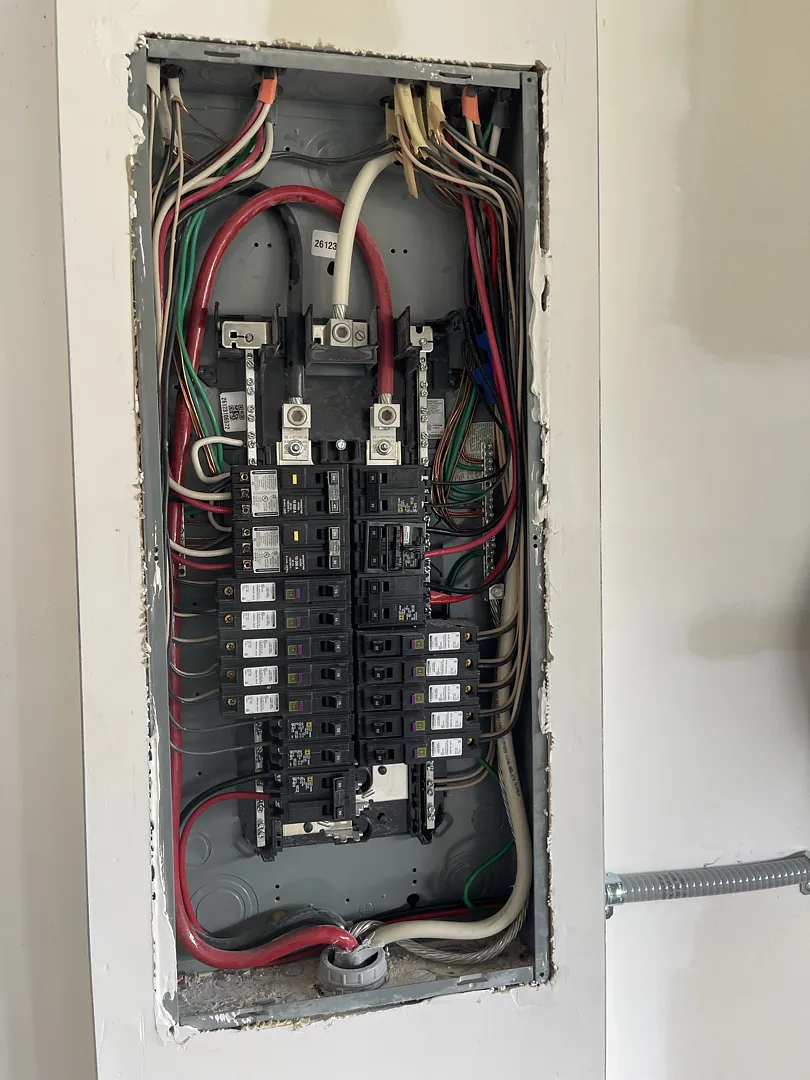
Many homeowners assume a Level 2 charger must be paired with a new electrical panel. In reality, the panel decision should come after reviewing the home's electrical demand, the existing equipment and the charging speed the driver actually needs.
Breaker space and electrical capacity are not the same thing
An open space in the panel may provide a physical location for a new breaker, but it does not prove that the electrical service can support the additional load. The opposite is also true: a panel that appears full may still have a code-compliant path to home charging without replacing the entire service.
A proper evaluation looks beyond the cover. It considers the service rating, existing household loads, panel condition, breaker configuration, charger requirements and the charging amperage being proposed.
When a panel upgrade may be the right recommendation
We are more likely to discuss an upgrade when the panel needs significant modernization independent of the charger—or when it cannot safely accommodate the project after the realistic alternatives are considered.
- Age and condition: Equipment more than roughly 25 years old deserves closer inspection, especially when wear, corrosion, heat damage or deterioration is visible.
- Electrical or code problems: Poor prior modifications, damaged components or other significant deficiencies may make improvement the responsible long-term choice.
- No workable breaker space: A crowded panel may require reconfiguration, a subpanel or replacement depending on the listed equipment and the overall design.
- Insufficient capacity: If the existing household demand already leaves too little capacity for the proposed charging load, the design must change.
- Broader electrical plans: A homeowner adding an EV alongside electric HVAC, a water heater, pool equipment or other major loads may benefit from planning beyond a single charger circuit.
Options that may avoid an unnecessary upgrade
When the panel itself remains serviceable, the solution may be to design the EV charging system around the capacity that is actually available.
Choose the charging rate the driver actually needs
The fastest charger setting is not automatically the best setting. Many drivers can replenish their normal daily mileage overnight at less than the charger's maximum output. Selecting an appropriate charging rate can reduce the added load while still providing dependable home charging.
Use dynamic load management when appropriate
Dynamic load management monitors household electricity use and adjusts the EV charging rate as other loads turn on and off. The charger can use more available power when household demand is low and reduce its output when demand rises.
Compatible options may include
Compatibility and the final design must be confirmed for the individual home.
How Go Electric Chargers evaluates the home
We begin with panel photos, the charger model and the planned charger location. From there, we evaluate the electrical setup and the homeowner's charging goals before recommending the circuit size or panel solution.
- Review the panel: service rating, breaker layout, equipment age and visible condition.
- Understand the charger: model, maximum output and available load-management features.
- Match the charging goal: daily driving, overnight charging window and desired speed.
- Recommend the practical path: a standard circuit, adjusted charging rate, load management or panel work when genuinely needed.
The bottom line
You should not approve an expensive electrical panel upgrade based only on the assumption that every Level 2 charger requires one. You also should not force a high-output charger onto a panel that is overloaded, deteriorated or poorly configured. The best answer comes from evaluating the complete electrical system and choosing the charging design that fits the home.
Go Electric Chargers provides EV-focused panel and capacity evaluations for homeowners in Orlando, Sarasota and surrounding Florida communities. Learn more about our electrical panel solutions, dynamic load management and home EV charger installation.
Before upgrading the panel, let's make sure you need to.
Send us your charger details and clear panel photos for an initial project review.
Frequently asked questions
Can I install an EV charger without upgrading my electrical panel?+
Often, yes. The answer depends on the home's available electrical capacity, panel condition, breaker space, charger requirements and desired charging rate. Load management or a lower charging setting may also provide a practical alternative.
Does an open breaker space mean my panel can support an EV charger?+
Not necessarily. Physical space for a breaker and sufficient electrical capacity are two different questions. A proper evaluation considers the home's existing loads in addition to the panel layout.
What if my electrical panel is full?+
A full panel does not automatically require a complete upgrade. Depending on the equipment and electrical design, possible solutions may include approved breaker arrangements, a subpanel, load management or a panel replacement. The system must be evaluated before choosing an option.
Can dynamic load management prevent a panel upgrade?+
In the right home, it can. Dynamic load management monitors household demand and adjusts EV charging to remain within the configured electrical limit. It does not repair an aging, damaged or unsuitable panel, so the condition of the equipment still matters.
Should a panel over 25 years old be replaced before adding an EV charger?+
Age is an important reason to inspect the panel, but age alone does not determine the answer. Condition, manufacturer, available capacity, previous modifications and code or safety concerns all need to be considered.